Olivia hadn’t planned to spend the weekend alone.
In fact, if someone had suggested it a year earlier, she probably would have laughed.
Her life was built around schedules.
Meetings.
Phone calls.
Emails.
Deadlines.
Every day seemed to begin with a to-do list and end with another one waiting for the morning.
For nearly fifteen years, she had worked in a busy marketing firm in the city.
The work was rewarding, but it was also exhausting.
Even when she wasn’t working, part of her mind remained occupied.
She checked messages during dinner.
Thought about projects while falling asleep.
Reviewed plans while drinking her morning coffee.
Somewhere along the way, being busy had become normal.
So normal that she barely noticed it anymore.
Until one Thursday afternoon.
Olivia sat at her desk staring at a presentation she had revised six times.
Her eyes felt tired.
Her shoulders ached.
Outside the office window, traffic crawled through the city streets.
People hurried along sidewalks.
Everyone seemed to be rushing somewhere.
For the first time in months, perhaps years, Olivia asked herself a simple question.
“When was the last time I truly rested?”
The answer didn’t come easily.
That realization concerned her.
Later that evening, she remembered a small cabin her aunt owned beside a lake several hours outside the city.
The cabin sat empty most of the year.
Occasionally family members visited for a few days.
Mostly it remained quiet.
Waiting.
Without allowing herself time to reconsider, Olivia called her aunt.
The cabin was available.
By Friday afternoon, she was driving away from the city.
At first, she felt guilty.
There were emails she could answer.
Tasks she could complete.
Projects she could prepare.
Part of her wanted to turn around.
But another part of her felt relieved.
The farther she drove, the quieter her thoughts became.
Tall buildings disappeared.
Traffic faded.
Open fields replaced highways.
The landscape gradually transformed into forests and rolling hills.
Hours later, she turned onto a narrow gravel road.
Trees lined both sides.
Sunlight filtered through the branches.
The road curved gently toward the lake.
Then she saw it.
The cabin.
Small.
Simple.
Peaceful.
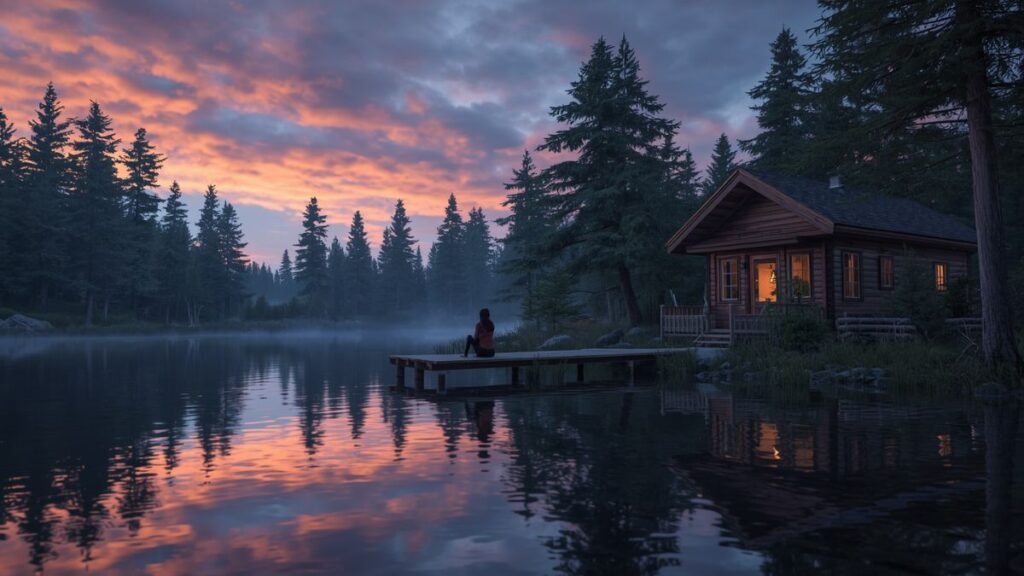
It stood near the water’s edge surrounded by pine trees.
A wooden dock extended into the lake.
A rocking chair sat on the front porch.
The scene looked almost unchanged from childhood memories.
Olivia parked the car and stepped outside.
Silence greeted her.
Not complete silence.
The kind filled with natural sounds.
Birds singing.
Leaves rustling.
Water moving gently against the shore.
The absence of city noise felt almost strange.
She hadn’t realized how accustomed she had become to constant sound.
For several minutes, she simply stood there.
Breathing.
Listening.
Looking.
The lake stretched before her like a sheet of glass.
The late afternoon sun reflected across its surface.
Everything felt calm.
The cabin itself was modest.
One bedroom.
A small kitchen.
A living room centered around a stone fireplace.
Shelves filled with old books.
Large windows overlooking the lake.
Nothing luxurious.
Nothing complicated.
Exactly what she needed.
After unpacking, Olivia sat on the porch with a cup of tea.
Normally she would have reached for her phone.
Checked notifications.
Reviewed messages.
Instead, she left the device inside.
For the first time in years, she had nowhere she needed to be.
No deadlines.
No meetings.
No expectations.
The feeling was unfamiliar.
And surprisingly comforting.
As evening approached, the sky transformed into shades of gold and orange.
The lake reflected every color.
Olivia watched quietly.
The sunset seemed slower here.
Longer.
More noticeable.
In the city, sunsets often disappeared behind buildings before she had time to appreciate them.
Here, nothing blocked the view.
She remained on the porch until darkness arrived.
Stars appeared overhead.
Hundreds of them.
Perhaps thousands.
She couldn’t remember the last time she had seen so many stars.
The sight reminded her of childhood camping trips.
Back when evenings felt endless.
Back when she noticed things.
A cool breeze drifted across the lake.
Olivia smiled.
She already felt different.
Not dramatically different.
Just lighter.
The following morning, sunlight entered through the cabin windows.
No alarm clock woke her.
No urgent notifications demanded attention.
Only birdsong.
For a moment she remained in bed listening.
The experience felt luxurious.
Simple, but luxurious.
After breakfast, she decided to walk around the lake.
The trail wound through trees and open clearings.
Wildflowers appeared beside the path.
Occasionally she stopped simply to observe.
A squirrel gathering food.
A dragonfly hovering above the water.
Sunlight dancing through leaves.
Ordinary things.
Yet somehow fascinating.
The walk lasted nearly two hours.
Normally she would have considered that unproductive.
Now it felt valuable.
Later that afternoon, Olivia discovered an old journal tucked inside a drawer near the fireplace.
The cover appeared worn from years of use.
Curious, she opened it.
The first entries belonged to her grandfather.
Years earlier, he had spent many summers at the cabin.
His handwriting filled page after page.
The journal wasn’t extraordinary.
It contained observations.
Thoughts.
Reflections.
Simple records of daily life.
One entry caught her attention immediately.
It read:
“The lake teaches patience.
Nothing here rushes.
The water arrives at the shore when it arrives.
The seasons change when they are ready.
The stars appear at their own pace.
Nature seems unconcerned with deadlines.”
Olivia smiled.
The words felt surprisingly relevant.
She continued reading.
Another entry said:
“People often confuse activity with progress.
Sometimes the most productive thing you can do is sit quietly and think.”
That sentence stayed with her.
Perhaps because it challenged how she lived.
For years she measured success through movement.
Accomplishment.
Productivity.
Efficiency.
Yet sitting beside the lake, she began wondering whether she had overlooked something important.
Rest.
Reflection.
Stillness.
Those things mattered too.
That evening, Olivia carried a chair to the end of the dock.
The lake remained calm.
A gentle breeze moved across the water.
Clouds drifted slowly overhead.
For nearly an hour, she sat without doing anything.
No reading.
No planning.
No distractions.
Just observing.
At first, her mind resisted.
Thoughts about work appeared.
Responsibilities resurfaced.
Plans demanded attention.
Gradually those thoughts faded.
The longer she sat, the quieter her mind became.
The experience felt surprisingly refreshing.
Like clearing clutter from a crowded room.
The next day followed a similar rhythm.
Wake naturally.
Walk.
Read.
Sit by the lake.
Watch the sunset.
Nothing remarkable happened.
Yet everything felt meaningful.
By Sunday afternoon, Olivia noticed something interesting.
She no longer felt the urge to constantly check her phone.
She no longer felt guilty for resting.
The pressure she carried so often seemed lighter.
Not gone.
But lighter.
The lake hadn’t solved her problems.
The cabin hadn’t transformed her life.
Yet both had reminded her of something important.
Rest was not wasted time.
Quiet moments held value.
Constant activity was not always necessary.
As evening approached, Olivia walked to the dock one final time.
The weekend was ending.
Tomorrow she would return to the city.
Back to meetings.
Back to deadlines.
Back to everyday responsibilities.
Yet she knew something had changed.
Not externally.
Internally.
She looked across the water.
The sunset painted the sky with familiar colors.
Golden light stretched across the lake.
The scene felt peaceful.
Timeless.
Her grandfather’s journal rested beside her.
She opened it once more.
Near the back, she discovered a final entry.
Short.
Simple.
Yet unforgettable.
It read:
“Life moves quickly enough on its own.
You don’t need to help it hurry.”
Olivia laughed softly.
Then she closed the journal.
The words felt like advice delivered across generations.
Advice she needed to hear.
The stars appeared one by one as darkness settled across the lake.
The same stars her grandfather had watched years earlier.
The same stars countless people had admired before him.
Some things remained unchanged.
And perhaps that was comforting.
The next morning, Olivia packed her belongings.
Before leaving, she stood on the porch one final time.
The lake shimmered beneath the morning sun.
Birds crossed the sky.
The cabin looked exactly as it had when she arrived.
Yet she felt different.
More grounded.
More present.
More aware of how important quiet moments could be.
As she drove away, she promised herself something.
She would return.
Not because the cabin was magical.
Not because the lake possessed extraordinary powers.
But because places like this reminded her of what mattered.
Balance.
Presence.
Rest.
Gratitude.
The road eventually led back toward the city.
Traffic reappeared.
Buildings returned.
Life resumed its familiar pace.
Yet a small part of the lake remained with her.
A reminder that slowing down isn’t falling behind.
Sometimes it’s exactly what we need.
Reflection
Modern life often encourages constant activity, but rest is just as important as productivity. Quiet moments of reflection help us reconnect with ourselves, appreciate the present, and remember that life does not need to be rushed in order to be meaningful.